Performance Marketing Explained: Metrics, Channels & Examples
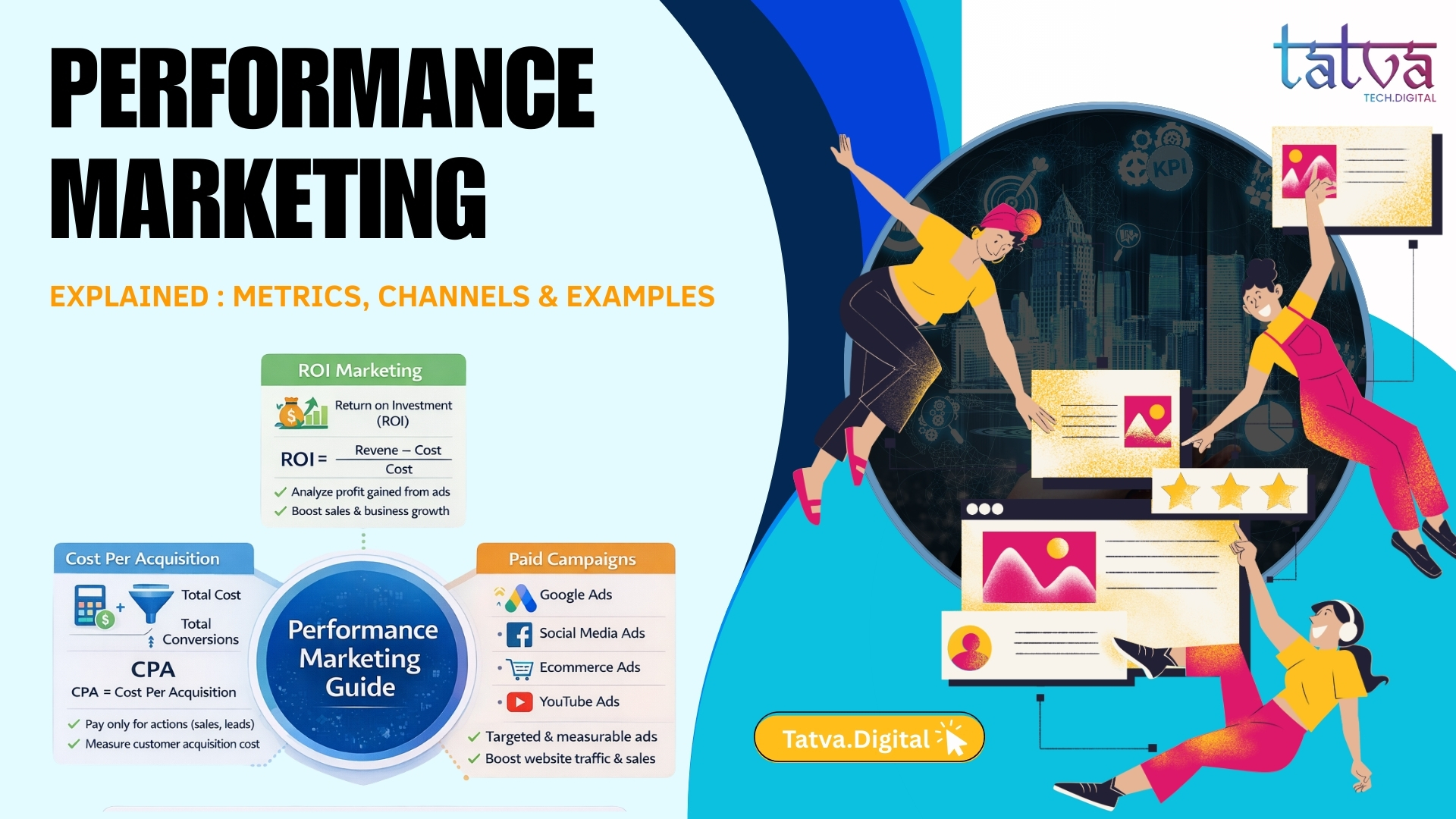
Your Complete Guide to Data-Driven, Results-Focused Digital Marketing In today’s fast-moving digital world, businesses can no longer afford to spend money on marketing and simply hope for the best. That is exactly why performance marketing has become the go-to strategy for brands that want real, measurable results. Whether you are looking to improve your ROI marketing, reduce your cost per acquisition (CPA), or launch high-performing paid campaigns across channels like Google, Meta, and affiliate networks — performance marketing puts you in control of every rupee you spend. At Tatvatech Digital, a trusted IT Company in Noida and one of the most recognized Modern Tech Solutions Providers in Delhi NCR, we help businesses of every size unlock the full power of performance-based advertising. From strategy to execution, our expert team makes sure every campaign delivers. In this blog, we will walk you through everything you need to know about performance marketing — what it is, how it works, which metrics matter, which channels to use, and real-world examples that show it in action. What Is Performance Marketing? Performance marketing is a results-driven form of digital marketing where advertisers only pay when a specific action is completed. That action could be a click, a lead, a sale, a download, or any other measurable outcome. Unlike traditional marketing, where you pay upfront and hope for results, performance marketing ties every rupee to a real business outcome. In simple terms: you pay for performance, not promises. This approach gives businesses full visibility into what is working and what is not. With the right performance marketing strategy, brands can scale their paid campaigns intelligently, reduce wasted spend, and consistently improve return on investment (ROI). According to a 2026 industry report, over 65% of digital marketing budgets globally are now allocated to performance-based channels — a number that has grown by more than 40% in the last five years. Key Performance Marketing Metrics You Must Know Before diving into channels, let’s talk numbers. Performance marketing lives and dies by metrics. Here are the most important ones: 1. Cost Per Acquisition (CPA) Cost Per Acquisition (CPA) tells you how much you are spending to acquire a single customer or convert a lead. For example, if you spend ₹10,000 on a campaign and get 100 conversions, your CPA is ₹100. The lower your CPA, the more efficient your campaign is. This is one of the most critical metrics in ROI marketing. 2. Return on Ad Spend (ROAS) ROAS measures the revenue you earn for every rupee spent on advertising. A ROAS of 4x means you earn ₹4 for every ₹1 spent — a strong performance benchmark for most industries. 3. Click-Through Rate (CTR) CTR shows what percentage of people who saw your ad actually clicked on it. A higher CTR generally means your ad creative and targeting are working well. Industry average CTR for Google Search Ads hovers around 3–5%. 4. Conversion Rate (CVR) Conversion rate is the percentage of visitors who take the desired action after clicking your ad. Even a 1% improvement in CVR can significantly boost your campaign ROI. 5. Cost Per Lead (CPL) CPL measures the cost to generate a single qualified lead. This metric is especially important for B2B businesses and service-based industries. 6. Customer Lifetime Value (CLV) CLV tells you how much total revenue a customer will generate over their entire relationship with your brand. Smart marketers always balance CPA against CLV to decide how much they can afford to spend on acquisition. 7. Impressions & Reach While not a direct performance metric, impressions and reach give you visibility into how many people your campaign is reaching — useful for brand-awareness-focused performance campaigns. Types of Digital Marketing: An In-Depth Look To truly understand performance marketing, you first need to understand the broader landscape of digital marketing. Here is a deep dive into the major types: 1. Search Engine Marketing (SEM) / Pay-Per-Click (PPC) SEM is one of the most popular performance marketing channels. Using platforms like Google Ads, businesses bid on keywords and pay only when someone clicks on their ad. PPC campaigns are highly targetable, measurable, and scalable. For example, a business in Noida targeting ‘best IT services Delhi NCR’ can reach exactly the right audience at the right moment. On average, businesses make ₹2 in revenue for every ₹1 they spend on Google Ads — making it one of the highest-ROI paid campaign options available. 2. Social Media Marketing (SMM) Platforms like Meta Ads (Facebook & Instagram), LinkedIn, and Twitter/X allow brands to run paid campaigns with pinpoint targeting based on demographics, interests, behavior, and more. Social media ads are especially powerful for B2C brands looking to drive awareness, engagement, and conversions simultaneously. Social media advertising spend in India alone crossed ₹25,000 crore in 2024, growing at 22% year-on-year. 3. Affiliate Marketing Affiliate marketing is a pure performance-based model where publishers (affiliates) promote your products and earn a commission only when a sale or lead is generated. This is an extremely cost-effective way to scale reach with zero upfront risk. Large e-commerce brands report that affiliate marketing contributes up to 16% of their total revenue. 4. Email Marketing Email marketing remains one of the highest-ROI digital channels available. It involves sending targeted, personalized messages to your subscriber list to nurture leads, promote offers, and retain customers. The average email marketing ROI is ₹3,600 for every ₹100 spent — making it a cornerstone of any performance marketing strategy. 5. Content Marketing Content marketing uses blogs, videos, infographics, podcasts, and other content to attract, engage, and convert audiences organically. While it takes time to build, great content drives compounding returns — especially when paired with strong SEO. According to Hubspot companies that blog consistently generate 67% more leads per month than those that don’t. 6. Search Engine Optimization (SEO) SEO is the process of optimizing your website to rank higher in search engine results pages (SERPs) organically. It involves keyword research, on-page optimization, technical SEO, link building, and content creation. Strong … Read more