Manufacturing ERP Solution In 2025 is undergoing one of the fastest digital transformations in history. Global supply chain disruptions, fluctuating customer demand, shrinking labor pools, and rising cost pressures have accelerated the need for intelligent systems that bring automation, visibility, and precision to daily operations. Manufacturers who once relied on spreadsheets, manual workflows, or rigid off-the-shelf ERP systems now realize that survival—and growth—require a far more adaptable solution.
This is where custom Manufacturing ERP solutions come into play. Unlike generic tools, these tailored systems are designed to reflect the true heartbeat of your factory floor. They integrate machines, people, data, supply chains, financials, scheduling systems, and quality processes into a single smart ecosystem. And with partners like tatvatech digital, manufacturers gain the ability to build an ERP that matches their exact operational DNA—something standard ERPs simply can’t deliver.
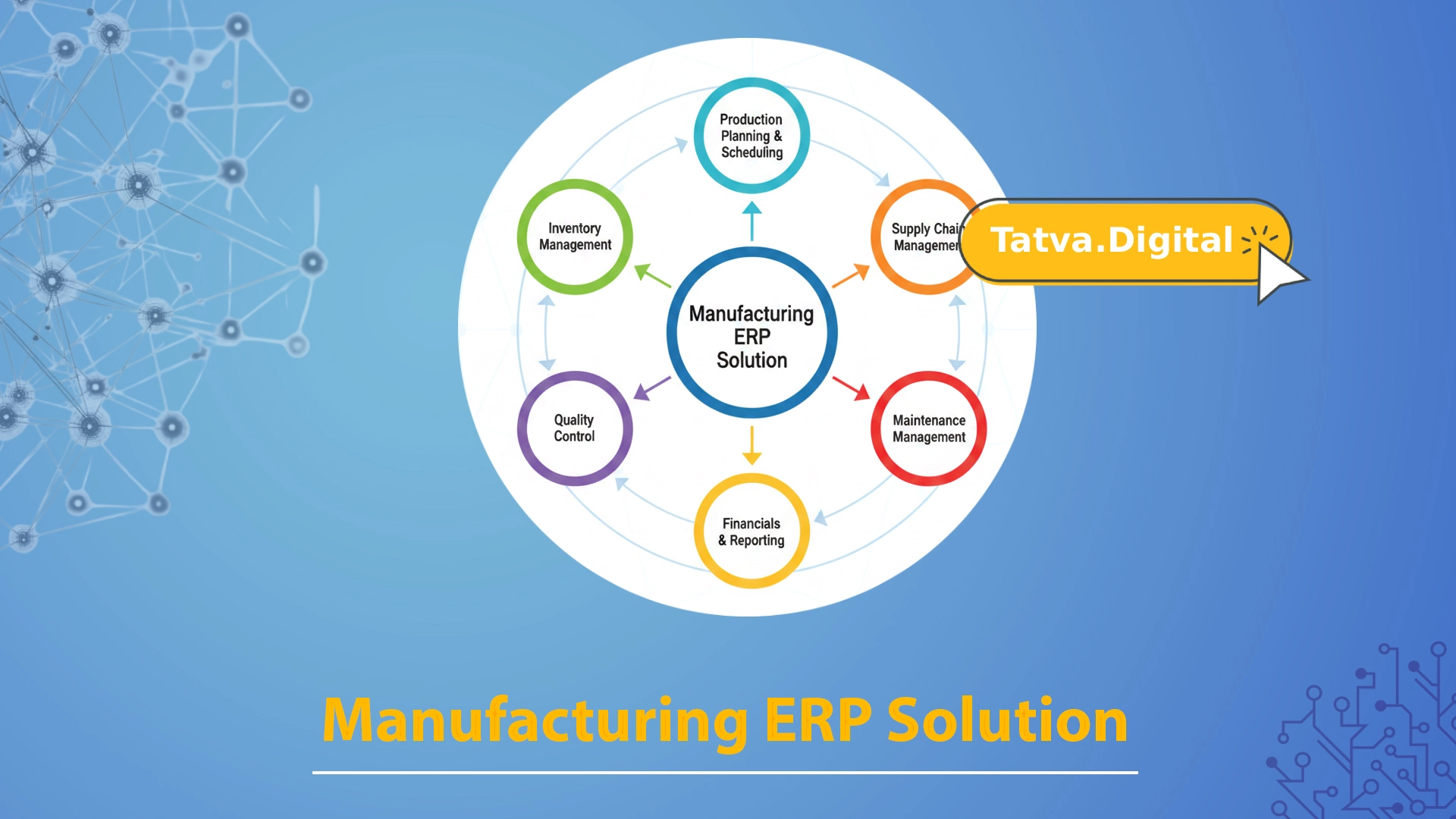
Production Planning & Scheduling, Supply Chain Management, Maintenance Management, Financials & Reporting, Quality Control, and Inventory Management.
Together, these functions create a highly efficient, data-driven manufacturing engine ready for the challenges of 2025 and beyond.
Let’s explore how they transform manufacturing operations at scale.
How Are Custom ERP Solutions Powering Production, Quality, and Maintenance Efficiency Like Never Before?
Manufacturing floors are incredibly dynamic environments. Machines break down unexpectedly. Demand fluctuates. Human errors occur. Schedules shift. Raw materials arrive late. A single disruption can ripple across the entire production chain.
Custom ERP development creates the real-time visibility and precision manufacturers need to stay ahead of these challenges.
1. Production Planning & Scheduling: The Brain of Modern Manufacturing
Production Planning & Scheduling at the top—and rightfully so. This is the core of any successful manufacturing operation. A custom ERP empowers planners with:
Real-Time Machine Capacity Visibility: Instantly monitor machine load, availability, and performance to plan efficiently.
Automatic Schedule Adjustments: The system auto-reschedules jobs based on machine downtime, delays, or priority changes.
Dynamic Routing Based on Constraints: Orders automatically route through the best machines, lines, or work centers based on capacity and limitations.
Order Prioritization with Drag-and-Drop Planning: Planners can easily rearrange job priority using a visual drag-and-drop scheduler.
Integration with Demand Forecasts and Customer Timelines: Production plans align automatically with real-time demand forecasts and customer delivery commitments.
Imagine a system that automatically reschedules a job because a machine needs maintenance, alerts procurement if materials will run short, and notifies operators instantly—all without manual effort. That is the power of custom ERP.
2.Quality Control: Ensuring Zero-Defect Manufacturing
Manufacturers cannot afford inconsistent quality. Custom ERP systems embed quality controls into every stage of production:
Incoming Material Inspections: Ensure every raw material meets quality standards before entering production.
In-Process Checks: Monitor product quality at every manufacturing stage to prevent defects early.
Tolerance Tracking: Automatically track dimensional and performance tolerances for precision manufacturing.
Automated Rejection Workflows: Instantly flag defects and trigger corrective actions without manual intervention.
Batch-Level Traceability: Trace every component, batch, or lot across the entire production lifecycle.
Compliance Documentation: Maintain audit-ready documentation that meets industry and regulatory standards.
If deviations occur, alerts are raised instantly. Data is captured automatically. And entire product genealogies can be traced in seconds.
3.Maintenance Management: Predictive Uptime in the IoT Era
Downtime is one of manufacturing’s most expensive problems. Custom ERP systems integrate with IoT sensors and machine monitoring tools to support:
Predictive Maintenance: Identify equipment issues in advance using sensor data and machine-learning insights.
Automated Work-Order Creation: Automatically generate maintenance tasks when thresholds are crossed or anomalies are detected.
Spare Parts Inventory Visibility: Track availability, usage, and reorder levels of critical spare parts in real time.
Maintenance Calendars and Logs: Maintain organized schedules, records, and service histories for every machine.
Downtime Trend Analytics: Analyze recurring downtime patterns to eliminate root causes and improve uptime.
This means machines no longer “surprise” your team with sudden failures. Instead, your ERP predicts issues before they occur.
With tatvatech digital, manufacturers can connect all three pillars—production, quality, and maintenance—into one synchronized command center.
How Do Custom ERP Systems Optimize Inventory, Supply Chain, and Financial Control in 2025?
If production is the heart of manufacturing, then inventory, supply chain, and finances are the veins and arteries that keep everything moving.
This section aligns with the image modules that create operational stability.
1. Inventory Management: Precision Stocking Without Guesswork
Inventory mistakes can cost millions—either through overstocking or shortages. Custom ERP solutions eliminate guesswork by offering:
- real-time material visibility across plants
- automated reorder points based on live consumption
- FEFO/FIFO controls for perishable or regulated products
- barcode and RFID tracking
- optimized safety stock levels
- WIP (Work-in-Progress) transparency
With dynamic forecasting and intelligent restocking, you never tie up unnecessary capital in inventory—or halt production due to stockouts.
2.Supply Chain Management: End-to-End Coordination Across Vendors
Supply chain disruptions have become the norm. Custom ERP systems help manufacturers strengthen predictability with:
- vendor performance analytics
- automated PO creation and tracking
- shipment and logistics visibility
- supplier portals
- lead-time variability insights
- alternate vendor recommendations
When materials are delayed, the ERP triggers warnings early, allowing planners to adjust schedules proactively.
3. Financials & Reporting: Profitability Through Data Visibility
Financial modules integrated with operational data provide powerful benefits:
- real-time cost tracking
- job costing and profitability analysis
- automated invoicing and billing
- budget monitoring
- variance analysis
- compliance-ready financial reports
- forecasting and scenario analysis
Executives gain clear visibility into the financial impact of production efficiency, supply chain performance, and labor utilization.
This financial clarity—combined with inventory and supply chain optimization—makes custom ERP Solution the ultimate business intelligence engine.
Why Are Integrations, AI, IoT Connectivity, and Analytics the Backbone of the 2025 Manufacturing ERP?
In 2025, technology isn’t just supporting manufacturing—it’s shaping it. Custom ERPs are becoming smarter through machine connectivity, AI-driven insights, predictive analytics, and seamless integration with other enterprise systems.
1.Seamless Integrations Create a Unified Manufacturing Ecosystem
A modern ERP must integrate with:
MES (Manufacturing Execution Systems): Connect production operations with real-time execution data for improved shop-floor control.
PLM (Product Lifecycle Management): Integrate product design, engineering changes, and lifecycle data into the ERP ecosystem.
WMS (Warehouse Management Systems): Synchronize warehouse movements, picking, put-away, and dispatch with ERP inventory modules.
CRM Platforms: Align customer orders, service requests, and sales forecasts directly with production and planning workflows.
CAD/CAM Tools: Link engineering designs to manufacturing processes to ensure accuracy, version control, and seamless production execution.
IoT Platforms: Connect machines, sensors, and devices for real-time visibility into performance, health, and output metrics.
Supplier and Logistics Systems: Enable automated communication, shipment tracking, and vendor coordination across the entire supply chain.
Integrations ensure data flows effortlessly without manual intervention. The outcome? A fully connected digital thread across your entire manufacturing lifecycle.
2.AI and Predictive Analytics: The Future of ERP Intelligence
AI elevates ERP from a transactional system to a strategic advisor. It provides:
AI-Based Scheduling Recommendations: Automatically optimize production schedules based on constraints and demand.
Predictive Maintenance Insights: Forecast machine failures before they occur to prevent downtime.
Demand Forecasting: Analyze trends to predict customer demand with higher accuracy.
Quality Anomaly Detection: Identify defects early using pattern-recognition and real-time analytics.
Cost Optimization Suggestions: Highlight inefficiencies and recommend cost-saving actions.
Inventory Optimization Models: Balance stock levels with intelligent, data-driven inventory strategies.
AI doesn’t just report what happened—it predicts what will happen and recommends what to do next.
3. IoT Connectivity for Real-Time Operations
When an ERP connects directly to machines via IoT sensors:
Production Counts Update Automatically: Output data flows directly from machines to the ERP without manual entry.
Downtime Reasons Are Captured Instantly: Every interruption is logged with precise cause codes in real time.
Machine Health Tracks in Real Time: Sensors continuously monitor performance, load, and condition.
Scrap and Yield Metrics Stay Accurate: Automated data collection ensures reliable scrap and yield tracking.
Predictive Alerts Reduce Maintenance Surprises: Early warnings notify teams before failures can occur.
4.Dashboards and Role-Based Reporting
Every role—from operators to CEOs—gets personalized dashboards:
Operators See Machine Instructions: Provide real-time task guidance and operational steps directly on the shop floor.
Supervisors See KPIs and Production Status: Monitor line performance, throughput, quality, and shift progress instantly.
Managers See Efficiency and Cost Trends: Track productivity metrics, resource utilization, and cost patterns for informed decisions.
Executives See Strategic Financial Insights: Gain high-level visibility into profitability, forecasting, and enterprise-wide performance.
This ensures clarity, performance alignment, and data-driven decisions across all levels.
With tatvatech digital, manufacturers gain a powerful, AI-ready ERP ecosystem capable of learning, evolving, and scaling over time.
Conclusion: Why Are Custom Manufacturing ERP Solutions the Key Competitive Advantage in 2025?
Manufacturing in 2025 is defined by speed, precision, automation, and resilience. Companies that continue relying on outdated or generic ERP systems will struggle with inefficiencies, limited visibility, and slow response times.
Custom ERP solutions—especially when built by expert partners like tatvatech digital—provide:
- deeper production control
- tighter inventory optimization
- stronger supply chain stability
- predictive analytics and AI support
- integrated quality and maintenance management
- real-time visibility across the entire enterprise
- lower long-term costs and higher ROI
- scalability for future technologies
The six interconnected modules from the image—Production Planning & Scheduling, Supply Chain Management, Maintenance Management, Financials & Reporting, Quality Control, and Inventory Management—together create a powerful digital manufacturing engine.
Manufacturers who embrace tailored ERP systems today will dominate their industries tomorrow.
FAQs
1. How is a custom ERP better than off-the-shelf ERP?
Custom ERPs are built around your exact processes, eliminating workarounds and improving efficiency.
2. Can a custom ERP integrate the six modules shown in the diagram?
Yes. All modules—production, supply chain, quality, finance, maintenance, and inventory—can be seamlessly connected.
3. Does tatvatech digital offer complete ERP development and support?
Absolutely. tatvatech digital delivers end-to-end ERP consulting, development, integration, and long-term support.
4. How long does it take to implement a custom ERP?
Typically 4–12 months depending on complexity, modules, and integrations.
5. Does a custom ERP support AI, IoT, and predictive analytics?
Yes. Custom ERPs are designed to be intelligent, future-ready systems capable of supporting automation, AI models, and machine connectivity.
About us:
Business Name – Tatvatech digital private Limited
Tatva Tech Digital Private Limited is an emerging eCommerce platform offering a wide range of products, including electronics, home essentials, fashion, beauty, health, and more—all with a focus on quality, convenience, and customer satisfaction through innovation and reliability. Under our brand DNA eStore, we aim to connect global customers with high-quality products that enhance everyday living.
Contact us:
Contact: +91-8130110203
Email: ecommerce@tatva.digital
Trade Name: TatvaTech Digital Private Limited
Address: A 8, Block B, Sector 68, Noida 201306, Uttar Pradesh, India.
Follow us for more updates:
Instagram: https://www.instagram.com/tatvatechdigitalpvtltd/
Facebook: https://www.facebook.com/share/1BY7FF4Kuy/
Twitter: https://x.com/tatvatechdigi
Youtube: https://www.youtube.com/@TatvaTechDigital
LinkedIn: https://www.linkedin.com/company/tatvatech-digital-pvt-ltd/